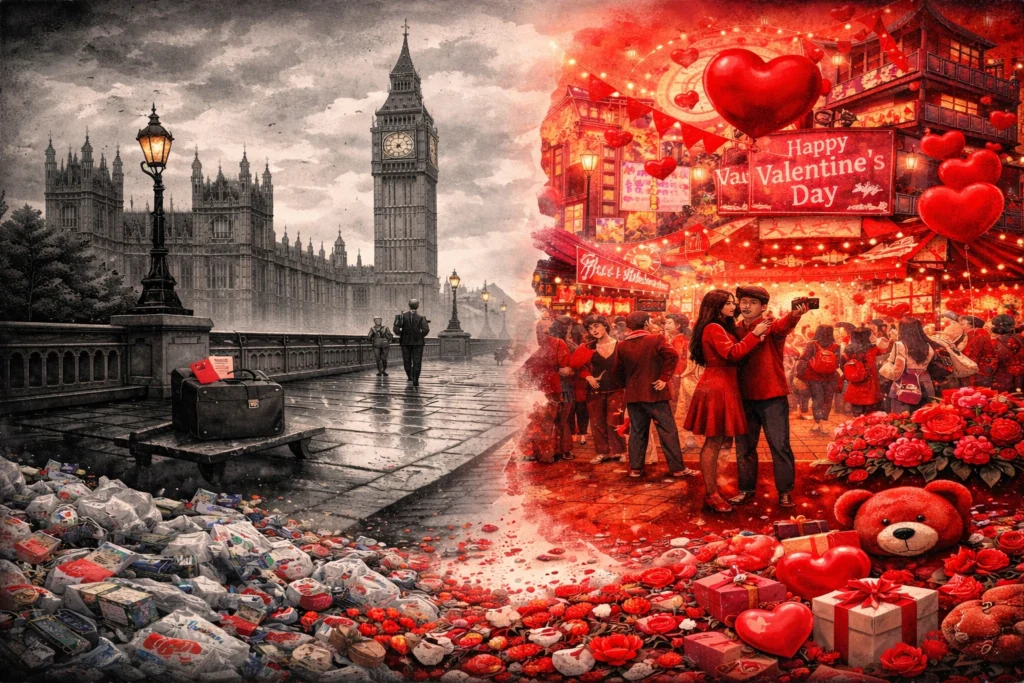
The streets of London on the morning of February 14th carry a surprising stillness. If one were to walk through the winding alleys of Hampstead or the bustling corridors of Canary Wharf, the expected explosion of scarlet and gold is nowhere to be found. There are no grand arches of balloons blocking the sidewalks and no armies of street vendors thrusting overpriced plastic roses into the hands of weary commuters. In the very heart of the culture that supposedly owns this tradition, Valentine’s Day has become a quiet, almost invisible footnote in the calendar. It is a day of modest gestures, perhaps a card tucked into a briefcase or a slightly more crowded evening at the local bistro, but it is by no means a defining cultural moment. The West has largely outgrown the performative spectacle of the day, viewing it with a mixture of weary cynicism and pragmatic restraint.
The Asymmetry of Enthusiasm
However, as we look toward the East, specifically the vibrant and chaotic urban centers of South Asia, a startlingly different reality emerges. From the high traffic intersections of Karachi to the sprawling malls of Delhi and Dhaka, the arrival of February signals a total sensory takeover. It is a red storm of such magnitude that it paralyzes public spaces and dominates the collective consciousness. In cities where local traditions are often pushed to the periphery by the pressures of modern life, this adopted Western holiday has been inflated into a garish, all-encompassing carnival. It is no longer a private exchange of affection but a public performance of status and consumption. This disparity presents a profound and alarming question regarding the nature of cultural influence. Why is the East doubling down on a tradition that the West is quietly discarding?
The phenomenon suggests a deep seated cultural insecurity, a blind mimicry where the copy has become far louder and more aggressive than the original. In the United Kingdom or across continental Europe, the commercial machinery behind Valentine’s Day is precise and targeted, yet it remains secondary to the flow of daily life. People there understand the holiday for what it is: a mid winter marketing push designed to bridge the gap between Christmas and Easter. They engage with it on their own terms, often with a self aware smirk at the cliches involved. There is no social pressure to transform the city into a crimson theatre. The red army of commercialism does not march through the streets of Paris with the same frantic energy that it does through the streets of Lahore.
“We are witnessing the birth of a non relevant carnival, a festival that has no roots in our history or our social fabric, yet demands more energy than many of our indigenous celebrations.”
The Vacuum of Cultural Identity
In South Asia, however, the adoption of this trend is devoid of that Western irony. It is pursued with a frantic, almost desperate sincerity. Every storefront is draped in artificial satin, and every digital screen flickers with reminders of romantic obligation. The scale of the celebration is entirely disproportionate to its cultural relevance. This is not merely a case of enjoying a global holiday; it is an example of deep work being applied to a shallow cause. The intellectual and creative resources of our marketing sectors, our youth, and our media are being funneled into sustaining a mirage.
The danger of this blind following cannot be overstated. When a society adopts the outward symbols of another culture without understanding the current context of those symbols, it risks becoming a caricature. We are chasing a version of the West that no longer exists. While the youth in London or Berlin are moving toward minimalism, self care, and a rejection of hyper consumerism, the youth in the East are being conditioned to believe that the height of sophistication is a giant teddy bear and a heart shaped box of imported chocolates. We are importing the discarded waste of Western consumerism and treating it as a sacred ritual of advancement.
The Price of Mimicry
This obsession reveals a terrifying void in our own cultural confidence. We seem to believe that by replicating the red storm with more intensity than the West, we are somehow proving our global relevance. In reality, we are doing the opposite. We are demonstrating that we are perennial followers, always ten steps behind the actual evolution of the cultures we admire. The West is not giving this day any significant importance anymore; it has been relegated to a minor commercial event. Yet, in our part of the world, we treat it as an essential pillar of the modern experience. We are building a cathedral of red plastic over a foundation of nothingness.
“We are building a cathedral of red plastic over a foundation of nothingness, proving our global relevance by celebrating what the West has already discarded.”
Furthermore, the economic impact of this imported carnival is staggering. Massive amounts of capital are drained from local economies to support the infrastructure of this one day event. The red army of vendors and international corporations thrives on the social anxiety of the Eastern middle class, who feel they must participate or risk being seen as uncultured or backward. This is a predatory cycle where the East pays a high price to mimic a Western lifestyle that the West itself is increasingly embarrassed by. The sheer volume of waste generated by this red storm is an environmental and social tragedy that goes largely unremarked upon in the rush to join the festivities.
A Call for Cultural Sovereignty
It is time for an alarming wake up call for the East. We must ask ourselves why we allow our public spaces to be hijacked by a tradition that serves neither our spiritual nor our cultural needs. We must question why we feel the need to be more Western than the West itself. If the originators of this tradition can treat it with a shrug and a quiet dinner, why must we turn our cities into crimson battlegrounds of forced affection? Our blind adherence to these fading Western trends is not a sign of progress; it is a symptom of a deep and troubling stagnation. We are looking in a mirror that reflects a world that has already moved on.
The cities of the East deserve a cultural identity that is not a second hand garment. We do not need the red storm to define our capacity for love or our engagement with the modern world. By continuing to follow these trends blindly, we ensure that we will always be the spectators of history, never the authors. We are investing our passion into a ghost, a hollowed out remnant of a tradition that has lost its soul even in the lands where it was born. It is time to dismantle the carnival and look toward a future that is defined by our own values rather than the fading echoes of a distant shore.
“The cities of the East deserve a cultural identity that is not a second hand garment; we must stop being the spectators of history and start becoming the authors.”
The West has moved into a phase of reflection and restraint regarding these commercial holidays, yet the East remains trapped in a fever dream of red tinsel. This disconnect is a warning sign of a cultural lag that we cannot afford to ignore. If we do not stop this blind mimicry, we will wake up to find that we have sacrificed our authentic social structures for a collection of empty boxes and wilted roses. The red army may look triumphant on the streets of our cities today, but it is an army of shadows, representing a victory for no one but the corporations who profit from our insecurity. It is time to see the red storm for what it truly is: a distraction from the deep work of building a culture that is genuinely our own.