
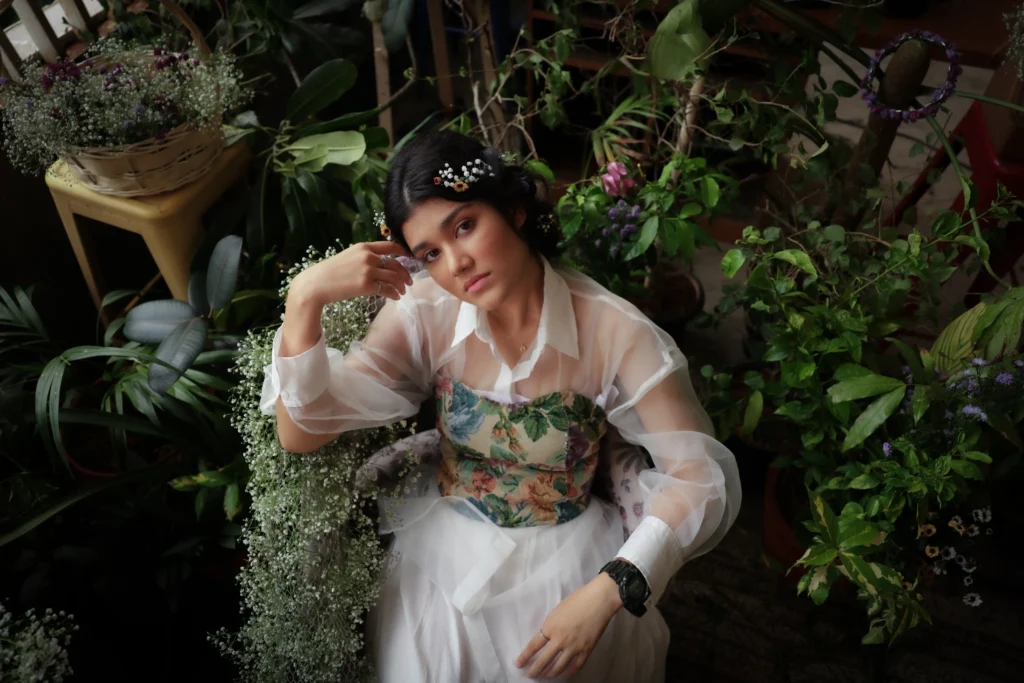
At fifteen, Gini already knew that music was not simply something she wanted to do. It was something she wanted to build her life around. She had been writing and playing instruments for years, but it was during a moment of profound loss that she truly understood what music could mean. In early 2021, after losing someone close to her unexpectedly, Gini wrote a song imagining the words he might have wanted to leave for his wife, words of reassurance, tenderness, and the promise that he would continue to look over her. She played the song for those gathered to celebrate his life. When she finished, the room fell silent. In that silence, something shifted. She realised that her words had reached a place where words were needed, perhaps helping people process something they had not yet been able to express themselves. It was then that she knew she wanted music to become her life.
That experience continues to live at the centre of the way Gini creates. Her songwriting is deeply personal, but it is never confined entirely to herself. She describes the process as picking up emotions that have been dropped, left behind, or forgotten as people move through their lives, then weaving them into the tapestry of her music. There is an almost tactile quality to the way she thinks about emotion. She wants her songs to feel like a blanket that comforts someone in a difficult moment, or a quiet sign that reminds them that being human does not have to mean suffering alone.
For Gini, art has the ability to make overwhelming feelings more manageable. A large emotion can become something gentler once it has been given a shape, a melody, or a place to exist. Her songs emerge from that understanding, carrying pieces of her own experiences while leaving enough space for listeners to recognise themselves within them. She does not simply want to tell people what she feels. She wants to create a place where they can feel it alongside her.
Her recent track FEEKA grew from one such realisation. Despite being a teenager, Gini had never really written about what it felt like to experience love while the mind itself was chaotic. Approaching her twenties, she found herself confronting the way she understood love and the space another person could occupy within her thoughts. The song became an exploration of that contradiction. She could exist independently, enjoy her own life, work towards everything she wanted, and still find herself unable to ignore the presence of someone who had begun taking up precious space in her mind.
The word feeka, meaning colourless or bland, captures the strange acceptance at the centre of the song. Rather than resisting the feeling, she allows herself to acknowledge that the world can seem a little less vivid without this person in it. In Gini’s hands, that acceptance does not become melancholy alone. It transforms the chaos into something almost celebratory, turning the confusion of emotion into a place where she can move, laugh, and exist freely.
Her relationship with music extends far beyond songwriting. As a producer, Gini remains intensely involved in the creation of her songs from their earliest stages. She cannot stay away from them. Simple layers of guitar or keys, vocals, and an abundance of harmonies often form the beginnings of a track before she brings other collaborators into the process. Even then, she remains deeply present, communicating ideas through sound and instinct, imagining strings, vocal textures, percussive elements, and the atmosphere she wants the music to create.
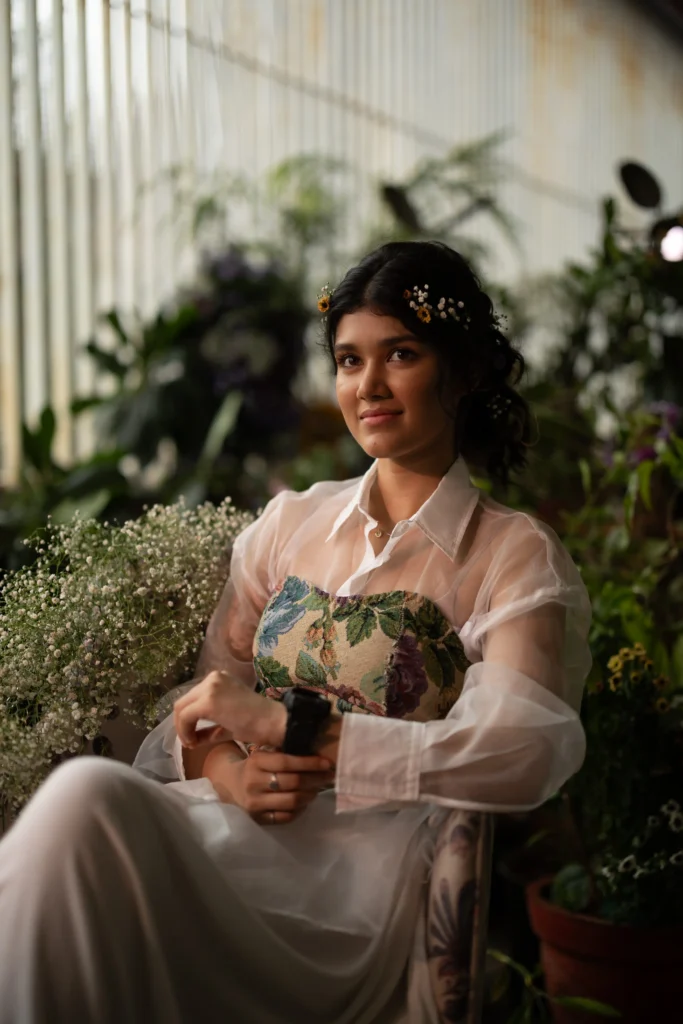
What makes her approach particularly distinctive is the way she visualises music beyond the recording itself. She thinks about how a song should feel when it is performed live, how the voice might become a landscape, how percussion can make something feel earthy or enormous, and how different elements can expand the emotional world of a song. Some of her most rewarding collaborations have been with friends who understand that world instinctively. By the end of a session, she says, they become almost like mind readers, communicating through an understanding that goes beyond technical production.
Authenticity, for Gini, can be measured in something wonderfully simple. If she does not enjoy playing a song live, she does not release it. She needs to feel as though she has returned to the room where the song first began, singing it for the first time again. Whether she is exploring a genre she currently loves or transforming a simple emotion into something much larger, the essential question is whether she can immerse herself completely in the song. That immersion is where she recognises herself.
The stage has given her another kind of freedom. Growing up, Gini often played alone, without the people around her who could help build the atmosphere she imagined. Performing alone meant feeling the full intensity of the lights, the attention, and the space surrounding her. Over time, however, performing with a band changed that experience completely. The friends who helped shape her live sound also helped turn the stage into a world she could disappear into.
Writing may begin as a solitary process for her, but performing with her band feels like a celebration. She describes herself as feeling freer and lighter on stage, moving around, having fun, and escaping into the small playground they create together. The live experience has taught her that music does not have to remain something contained within herself. It can become communal, physical, and alive.
In an era where music is increasingly discovered through fleeting moments online, Gini remains interested in something that can outlast the moment itself. She believes that songs endure when they make listeners feel understood, whether they remain present for decades or return to someone after years of being forgotten. Her ambition is not simply to create something that belongs to the present. She wants to make music she can be proud of, music that listeners can understand without needing an explanation from the person who wrote it.
Storytelling has become one of the ways she hopes to achieve that. Through lyrics, she can offer a perspective and allow someone else to step inside it. Her influences are as varied as her creative instincts, stretching from Radiohead and Billie Eilish to Swanand Kirkire, Haley Heynderickx, FINNEAS, Geeta Dutt, Kendrick Lamar, and Harry Belafonte. Each carries a different language of music, storytelling, emotion, and performance, and together they form part of the wide creative landscape from which Gini continues to learn.
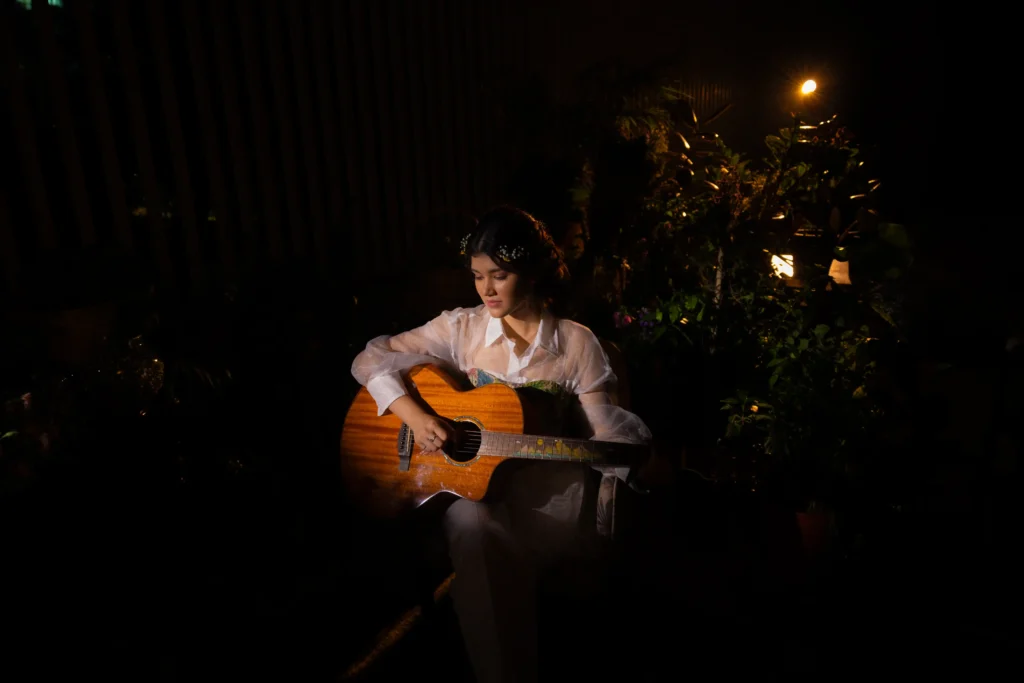
As her audience grows, there is one thing she wants them to understand above everything else: she is growing alongside her art. She does not see herself as someone who has arrived at a final artistic identity. Instead, she imagines each song as a small object offered with excitement, like a pebble an eager otter might bring to someone it wants to share something with. The listener can take it, keep it, or wait for the next one. There is something beautifully unguarded in that philosophy. She creates because she wants to share what she has discovered, without demanding that everyone experience it in exactly the same way.
Ultimately, Gini wants her music to become a soundtrack to other people’s lives. She wants listeners to place themselves inside her songs, to believe they are the person singing from that perspective even if they have never lived the experience themselves. That is perhaps the deepest expression of her artistry. She is not simply documenting her own life. She is creating emotional spaces where other people can find pieces of theirs.
The next chapter promises to take that idea even further. Gini is preparing an album that will bring listeners into her world from the age of eighteen to twenty, tracing the journey of a young woman determined to achieve something, see the world, encounter situations she could never have imagined, learn from them, and gradually carve herself into the person she wants to become. It is an album about growing through experience rather than around it, about allowing life to leave its marks while continuing to shape yourself with intention.
There is something fitting about Gini building her artistic identity around this period of becoming. Her music has always been interested in the space between feeling and understanding, between experience and expression. She takes the emotions people struggle to name and gives them somewhere to live. At this stage of her journey, she is still learning, still experimenting, still collecting the sounds and stories that will become part of her world. And perhaps that is precisely where her music finds its greatest strength, in the knowledge that becoming is not something to finish, but something to keep singing into existence.