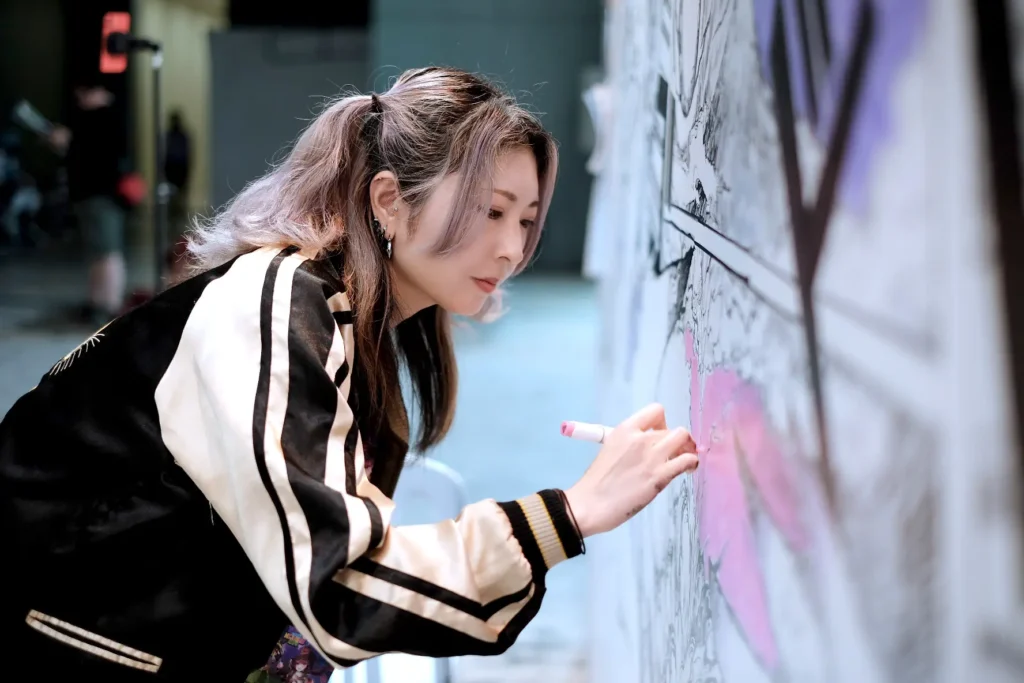
For Shinn Uchida, the journey into art was never about abandoning tradition but about finding a way to let it breathe beyond its constraints. Long before her large scale live paintings began captivating audiences across continents, she was, like many in Japan, an aspiring manga artist navigating an intensely competitive industry. For nearly a decade, she created tirelessly, yet her work remained unseen, confined by a system where publication determined visibility. The silence of that period became its own kind of pressure. It was this very limitation that led to a pivotal shift. If her stories could not reach people through conventional means, she would bring them directly into the public eye. Live drawing on monumental surfaces became her answer, transforming manga from something intimate and contained into something immediate, shared, and impossible to ignore.
This transition, however, brought with it a new set of artistic challenges. Traditional manga relies on intricate linework, delicate details that reward close attention. Translating that language onto large scale surfaces meant rethinking not just technique but perception. Lines had to be bold enough to be seen from a distance, yet still carry the nuance that defines the medium. It is a constant negotiation between strength and subtlety, between visibility and intricacy. Added to this is the pressure of time. Live performances demand completion within strict limits, requiring both precision and speed, a balance she continues to refine with each project.
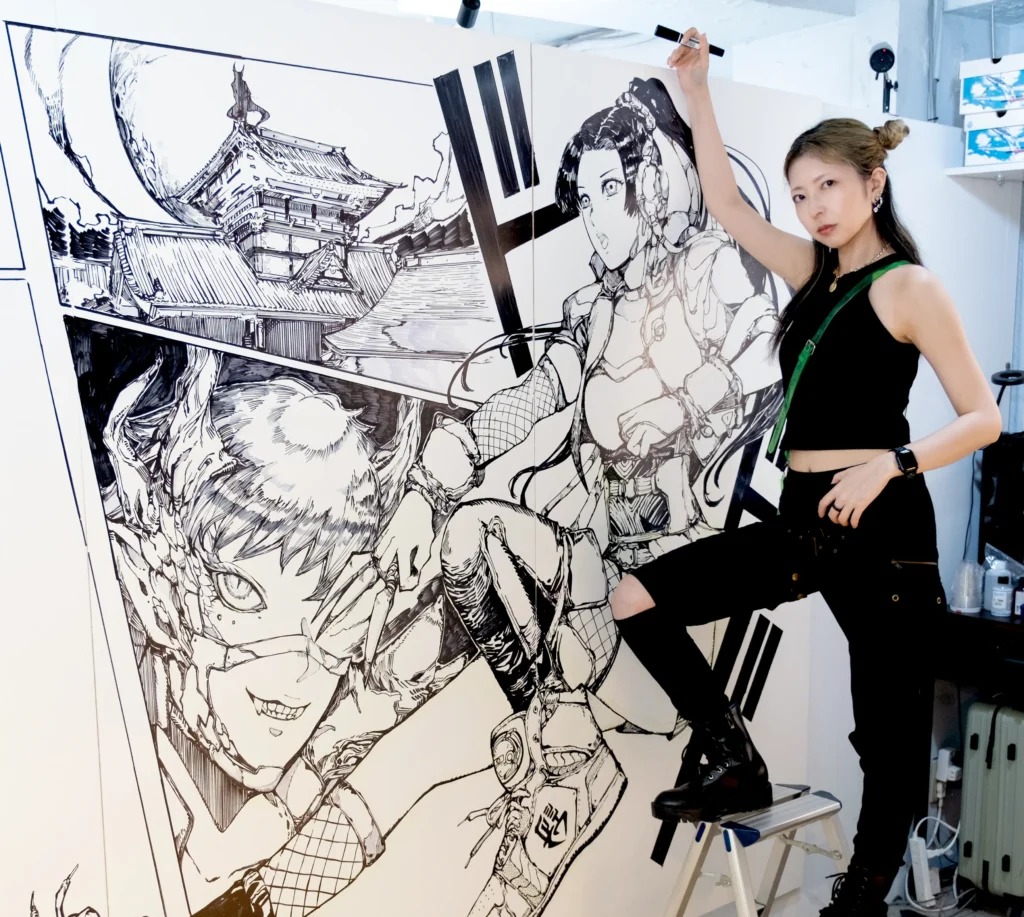
Unlike the solitude of studio work, live painting introduces an element of unpredictability that has become central to her process. Each environment brings its own energy, shaped by architecture, atmosphere, and audience. These external influences often find their way into the work itself, prompting spontaneous decisions that would never occur in isolation. It is within this immediacy that her art gains a unique vitality, evolving in real time rather than adhering strictly to preplanned outcomes.
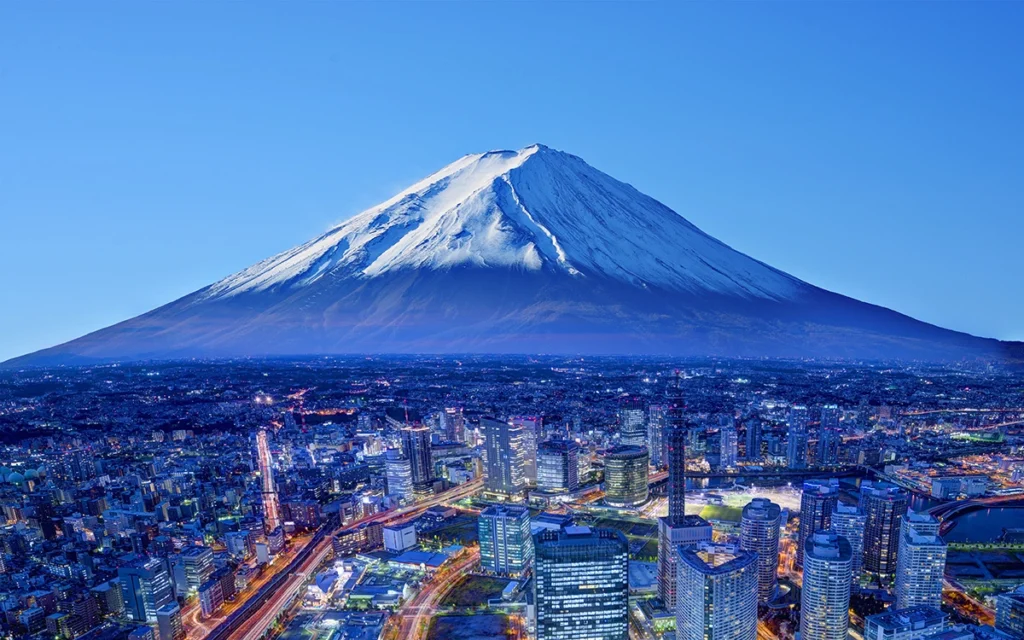
Her artistic identity is deeply rooted in the visual culture that shaped her, particularly the anime and manga of the 1980s and 1990s. Yet her inspiration extends beyond media into the physical landscape of Tokyo itself. The often overlooked details of the city, the spaces beneath elevated railways, the intricate network of pipes near train stations, the quiet presence of utility poles, all contribute to the layered aesthetic that defines her work. These elements merge with her signature cyberpunk sensibility, creating visuals that feel both nostalgic and distinctly contemporary.
Her creative process remains grounded in the fundamentals of manga creation, even when scaled to monumental proportions. When working with a defined brief, she begins by gathering references, constructing a narrative, and mapping out the composition much like a traditional manga layout. In more open settings, particularly at international pop culture events, she allows intuition to guide her, embracing the freedom to create in the moment. This balance between structure and spontaneity is what allows her work to remain both disciplined and alive.
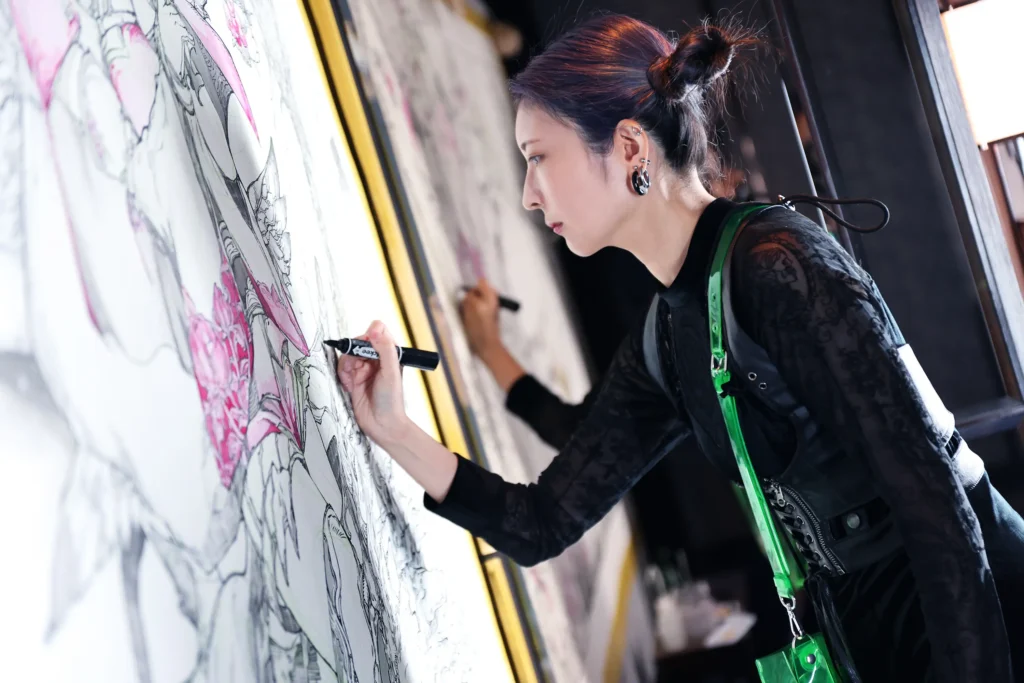
While digital tools play a role in her workflow, she approaches them with caution. They serve as support rather than foundation. The tactile nature of live drawing, the immediacy of hand to surface, remains essential to her practice. Even as technology makes large scale creation more accessible through tools such as augmented reality tracing, she chooses to rely on her own skill. At the same time, she acknowledges the importance of digital platforms in expanding her reach. Sharing her live drawing process online has introduced her work to a global audience, bridging the gap between traditional craft and contemporary visibility.
This global exposure has revealed an interesting dynamic. While manga is widely consumed around the world, few have witnessed its creation firsthand. Live drawing offers that rare insight, allowing audiences to experience the process rather than just the finished product. The response, she notes, is one of fascination. Her large scale works retain the essence of traditional manga, even as their scale and presentation transform the experience. The reception of her cyberpunk inspired visuals, in particular, reflects a growing appreciation for manga as a versatile and evolving form.
Among her many projects, one stands out as especially demanding. At drupa in Düsseldorf, one of the world’s leading printing and media trade fairs, she undertook the task of completing seven manga panels in eleven days at the RICOH Europa booth. The pace required her to produce nearly one panel per day, a challenge that tested not only her technical ability but also her endurance and discipline. It was an experience that reinforced the importance of stamina and time management, as much as artistic skill.
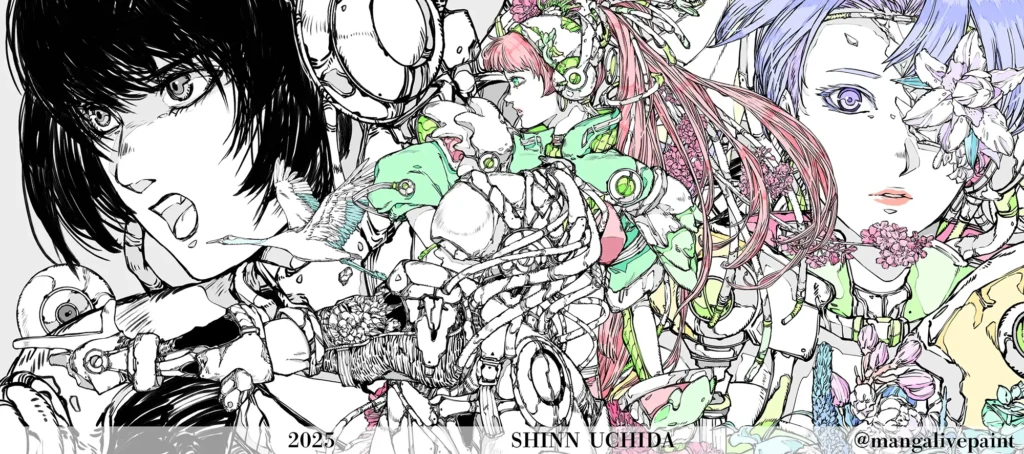
Despite the scale and intensity of her work, her approach to preparation remains understated. Mentally, she relies on a sense of steadiness rather than ritual, approaching each performance as she would any other day. Creatively, her preparation is practical, gathering references and ensuring she has the materials she needs. This simplicity allows her to remain focused and adaptable, qualities essential for live creation.
Looking ahead, she sees manga at an intriguing crossroads. In Japan, it is not always regarded as fine art, yet globally, its recognition continues to grow. The rise of social media has further accelerated this shift, enabling artists to share their work beyond traditional gatekeepers. For Shinn Uchida, this evolving landscape holds immense potential. The future of manga as an art form remains undefined, and it is precisely this uncertainty that excites her.
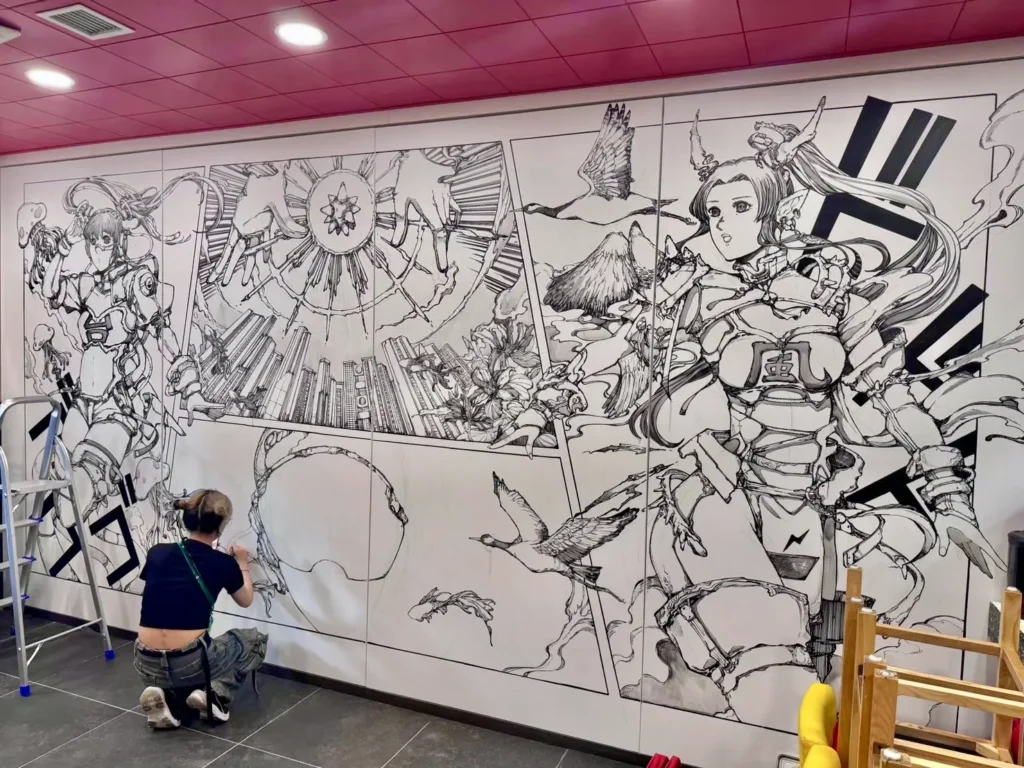
Her work stands as a testament to what happens when tradition is not confined but expanded. By taking manga off the page and into the world, she has not only redefined her own path but also invited audiences to see the medium in an entirely new light.