

HOW ASIA’S YOUTH ARE WEAVING CULTURAL LEGACY INTO TOMORROW’S MODERN WARDROBE
Across the vast and dynamic landscapes of East, South, and Southeast Asia, a quiet revolution is unfolding within the world of contemporary fashion. For generations, the trajectory of global style was largely dictated by the fashion capitals of the West, with traditional Asian garments often relegated to formal ceremonies, festive occasions, or dusty museum archives.
Today, however, a vibrant youth culture is radically altering this narrative by reclaiming their ancestral heritage and seamlessly weaving it into the fabric of daily urban life. Driven primarily by Generation Z consumers who are simultaneously hyper-connected to global digital networks and deeply curious about their cultural roots, fashion across the Asia-Pacific region has transformed into a living canvas where historical art forms meet modern design philosophies.
This renaissance is not merely a passing aesthetic phase; it represents a profound philosophical shift in how identity, technology, and tradition interact on the global stage.
At the absolute epicenter of this cultural movement is China’s phenomenon known as Guochao, or the national tide. What began as a subtle movement toward domestic brand preference has expanded into a full-scale creative rebirth that celebrates Chinese history, art, and philosophy through a contemporary lens. Younger generations are rejecting the notion that modern sophistication requires Western minimalist tailoring, choosing instead to elevate classical garments like the hanfu and the cheongsam into daily streetwear staples.

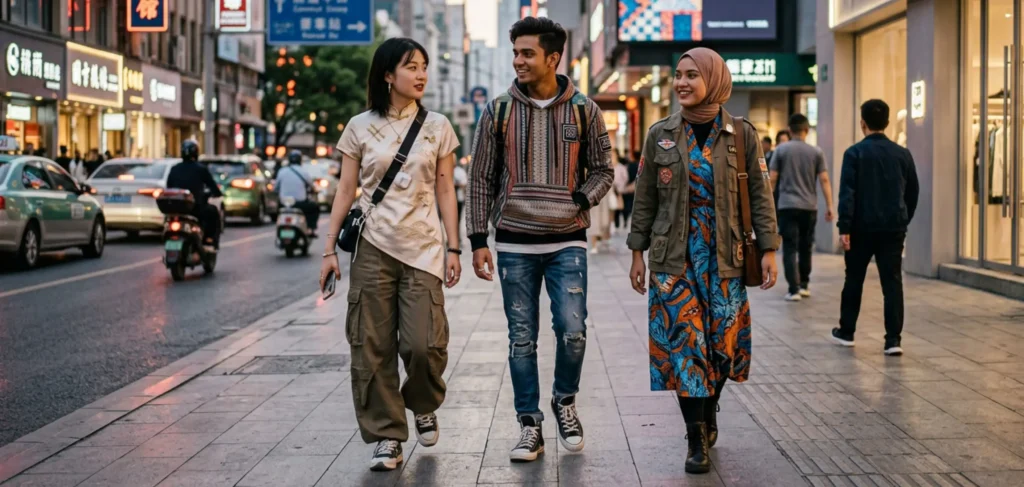
A modern city sidewalk in Shanghai or Chengdu might showcase an oversized denim jacket embellished with intricate Suzhou embroidery, or a sleek tailored blazer incorporating the asymmetric collar and delicate frog closures of traditional qipao garments. These designs do not look like historical costumes; rather, they feel urgently modern, blending the relaxed silhouettes of contemporary street style with the rich narrative depth of centuries-old craftsmanship.
This phenomenon extends far beyond Chinese borders, finding a powerful echo across Southeast and South Asia, where heritage craftsmanship is undergoing a similar modern revitalization. In countries like Indonesia and Malaysia, young designers are taking batik, a technique long associated with formal adult attire, and reinterpreting it for a younger, urban audience. Instead of rigid cut shirts, batik patterns are now digitally printed or hand-dyed onto oversized bombers, crop tops, cargo trousers, and casual dresses.
Similarly, in South Asia, traditional textiles like Bangladeshi Dhaka weaves and Indian handloom silks are being liberated from the confines of formal wear. Young creators are converting these exquisite woven fabrics into lightweight coats, modern streetwear hoodies, and fluid coord sets. Saree drapes are being simplified and reimagined with utilitarian belts, pre-stitched pleats, and comfortable cotton fabrics, allowing them to be worn effortlessly with sneakers to a coffee shop or a modern workplace.
What elevates this modern heritage movement beyond simple nostalgia is its deep integration with cutting-edge technology, creating what industry observers call heritage-tech fusion. Today’s young designers are using advanced digital tools to honor, preserve, and scale ancient artisan techniques that were once at risk of disappearing. Generative artificial intelligence, 3D digital garment modeling, and computer-aided loom programming allow creators to dissect complex historical patterns and reconfigure them in ways previously unimaginable. A classical embroidery motif can be digitized, scaled, and altered in real time to fit a modern geometric silhouette without losing the intricate integrity of the original artwork.
Furthermore, smart textiles and interactive elements are beginning to find their way into traditional attire, creating garments that respond to environmental temperature or feature embedded digital chips that tell the story of the artisan who crafted the fabric.
This technological synthesis also serves a vital role in consumer engagement and authenticity verification. Through simple digital scans, buyers can trace the origin of a garment, learning about the specific village where a handloom fabric was crafted or the historical meaning behind a particular motif. This transparency appeals directly to the values of modern consumers, who demand both cultural authenticity and ethical production practices. By linking modern supply chain tech with ancient artisanal communities, designers are creating a sustainable economic framework that keeps traditional craftspeople employed while delivering fresh, contemporary products to global markets.
Ultimately, this movement signifies a profound reclamation of cultural narrative. For decades, traditional Asian attire was viewed through an orientalist lens by global fashion houses, often sampled as exotic novelties without regard for history or context. Modern Asian youth are completely dismantling this dynamic. By wearing their heritage on their sleeves, quite literally, they express pride in their history without feeling bound by its rigidity. They treat tradition not as a static museum exhibit to be preserved under glass, but as a dynamic, living dialect that evolves alongside technology, music, and urban lifestyle.

As this fusion continues to mature, its impact will inevitably reverberate throughout the international fashion ecosystem. Global luxury brands are already taking note, shifting their approach from generic localized marketing to genuine collaborations with local Asian designers who understand the nuanced balance of heritage and modernity. The movement proves that the future of fashion does not require abandoning one’s past to appear forward-thinking. Instead, by leveraging technology to honor ancestral wisdom, the youth of Asia are proving that the most progressive aesthetic statement one can make is a proud, authentic expression of cultural identity.